

This post may contain affiliate links
Add Bake with Zoha as a preferred source on Google and find more of my tried-and-tested recipes.
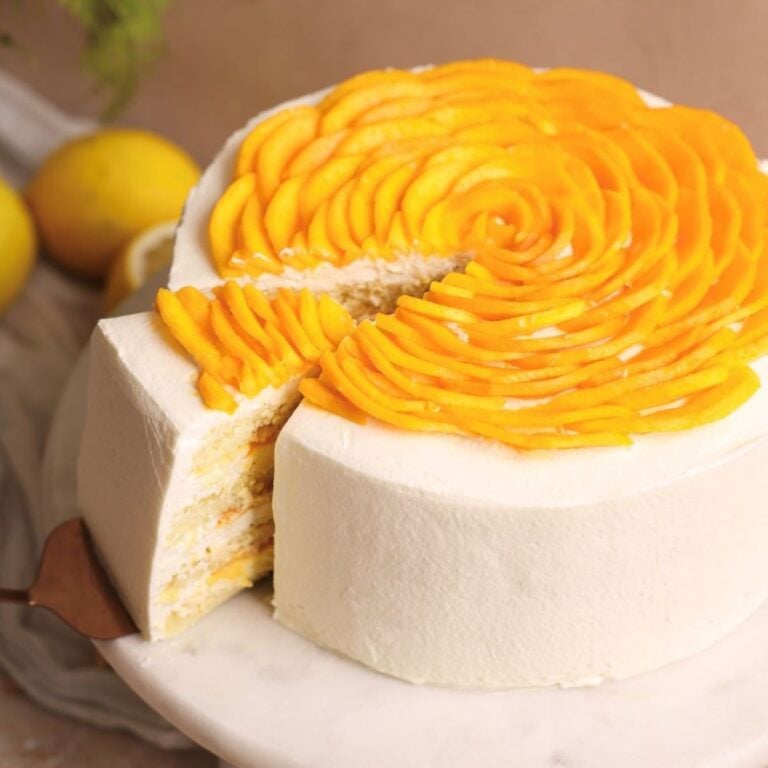
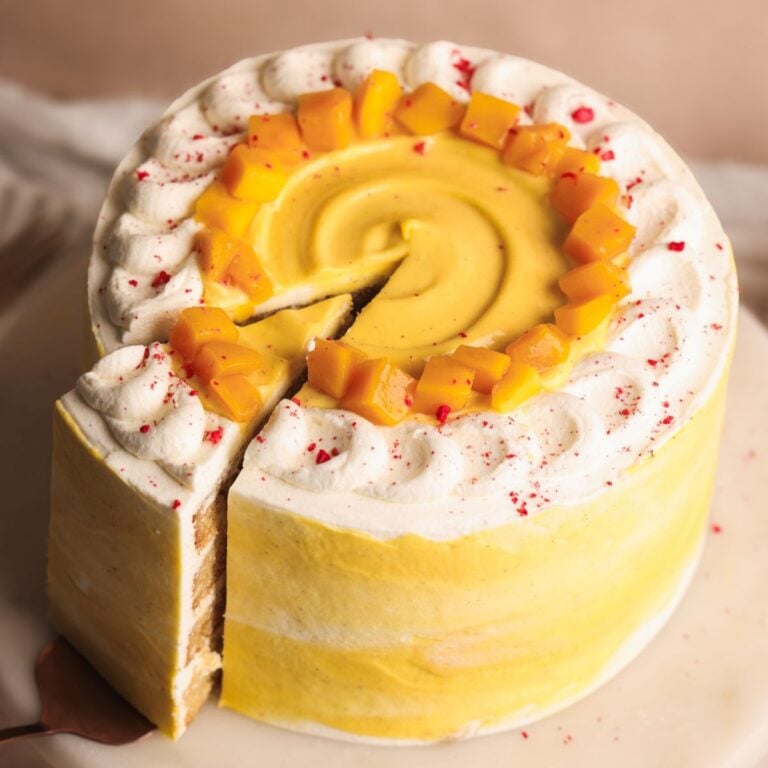
This Mango Cream Chiffon Cake needs a whole moment, a standing ovation, a monument. It is, hands down, one of the best, softest, yummiest cakes I’ve ever eaten. Imagine incredibly tender, cloud like chiffon cake layered with fresh and light whipped cream and delicious mango. The result is an absolute, melt in your mouth delight that I truly cannot recommend enough!


Read the full blog post below for detailed notes, tips, tricks, photos and videos.
Components Of This Mango Cream Chiffon Cake
This cake has 4 main components (don’t worry, though, besides the cake, they’re all extremely straightforward):
- Chiffon cake (more on this below)
- Mango simple syrup – this is used to soak the cake layers to ensure they’re very moist and to bring the mango flavor everywhere
- Whipped cream (or Chantilly cream) – a simple and light frosting that is perfect to complement this light, summery cake
- Fresh mangoes – these are blended to make a pulp that is added to each layer, and then sliced for decoration on top
What Is A Chiffon Cake?
A chiffon cake is a type of “sponge” cake with an ultra light, fluffy and airy texture. This texture is achieved by separating the egg whites from the yolks, and whisking them into a meringue which is then folded into the cake batter to result in a very airy batter. Traditionally, chiffon cakes do not use raising agents like baking powder or soda, as the air incorporated into the batter from the whisking technique helps them rise. Chiffon cakes also have a lower fat content than traditional butter / oil based cakes, with just a small amount of oil added to bring in some moisture.


Tips To Perfect This Mango Cream Chiffon Cake
There are 2 main things you need to nail to get this cake perfect: the chiffon cake sponge, and the frosting.
For the chiffon cake:
- Make sure there is no yolk in the egg whites, and use a clean bowl and whisk(s) for the meringue, as any trace amount of fat can cause it to deflate. To be on the safe side, dab a little vinegar on a paper towel and use it to wipe the bowl and whisk(s)
- Don’t rush the process of whisking the meringue. Whisk on medium speed while slowly adding the sugar. If you do this too fast, the meringue will deflate or separate
- Don’t under- or over-whisk the meringue. The meringue should be very glossy and hold shape in stiff peaks. Once it reaches this stage, stop whisking, as it can separate and become grainy
- Be very, very gentle when folding the meringue into the remaining batter. Use a rubber spatula in a gentle “J” folding motion, and lift the batter from the bottom of the bowl between folds. This will help ensure the denser cake batter mixes with the lighter meringue without knocking out the air
- Don’t grease the cake pans. Place parchment paper on the bottom, but don’t add oil, butter or spray. We want the cake to cling on to the edges of the pan to rise properly. If it fails to do that, it will shrink away from the edges and deflate when it comes out of the oven. When ready to remove from the pan, you can use a knife to gently release the cake
- Bake immediately. Once the batter is made, don’t let it sit out!
- Bake in a water bath. This allows for a slow and steady bake, and prevents the cake from developing a brown crust, which can get in the way of its rise
For the frosting:
- Whisk the cream to perfect stiff peaks. This means the cream has reached a pipeable consistency and holds shape, but is still a smooth texture. Whisking less will cause it to deflate and become runny, and whisking longer will cause it to become grainy and separate
- Keep the cream cold at all times. Use chilled cream to begin with, and keep refrigerated after whisking. Letting it sit out for too long will cause it to become runny. We don’t need to worry about stabilizing this whipped cream because the cake remains refrigerated anyway
- Make a whipped cream “dam” to hold the pulp between the layers. Since pulp is runny, we need to pipe cream around the edge of the cake before pouring it in. The cream ensures the pulp does not flow out from between the layers during or after assembly, which can quickly cause your cake to come apart!


Process With Photos
The recipe with detailed instructions is provided in the recipe box below, but let’s go over the steps at a high level with photos to help you visualize everything.
Whisk the egg whites while slowly adding in sugar until a glossy, stiff meringue forms:


Whisk the egg yolks with the remaining sugar and wet ingredients:


Sift in the dry ingredients and gently whisk them in:


Now gently fold the meringue into the yolk batter in ~2-3 additions:


Divide the batter between cake pans and bake:


Prepare the mango simple syrup and mango pulp, and set them aside (not pictured)
Whisk the heavy cream with sugar and vanilla until it forms stiff peaks:


Once the cakes have cooled, divide each into 2 layers and begin assembly. Brush each layer with the mango simple syrup:


Spread a thick layer of whipped cream, and pipe it around the edge. Then add the pulp:


Repeat with all layers, and frost the cake in whipped cream. Then decorate with sliced mangoes:


Slice up & enjoy!
Frequently Asked Questions
This can happen if your meringue isn’t properly whipped, or you are not gentle enough when folding it into the remaining batter. Read the section above on “tips to perfect this cake” for more details!
This can happen if you add too much flour (which is why I recommend a scale) or from overbaking. The cake will not become golden, so do a toothpick test and stop baking when it is done!
You can use any kind of fresh, in season mangoes that you like for this cake. I recommend more fleshy, less hairy, sweet mangoes for the best results. I was lucky to get my hands on some Pakistani “Sindhri” mangoes which were just an absolute delight! But in the past, I have also tried “yellow mangoes” and found they work out fine.
Unfortunately, I found canned mango pulp to be a bit too runny for this recipe. It ran out from between the layers, making assembly challenging. It is best to use fresh mangoes to make your pulp. If you must use canned pulp, make sure the whipped cream “dam” is well made to hold it in, and don’t add too much.
Yes, you can prepare this cake 1-2 days in advance and keeping it covered and refrigerated. I recommend adding the sliced mangoes for decoration when you’re ready to serve.
Keep this cake stored in an airtight container in the fridge for up to 5 days. If storing the full cake, wrap it in cling film to prevent it from drying out.

Email This Recipe
Enter your email and I’ll send this directly to you. Plus you’ll get new recipes from me every week!
Ingredients
Chiffon Cake:
- 6 large eggs, separated
- 1/2 cup granulated sugar (100g); divided into 1/4 cup and 1/4 cup
- 1/3 cup milk (80g)
- 3 tbsp vegetable oil (35g)
- 2 tsp vanilla
- 2/3 cup all purpose flour (85g)
- 1/4 cup cornstarch (40g)
- 1/4 tsp salt
- 1/4 tsp baking powder
Mango Simple Syrup:
- 1/4 cup water (60g)
- 2 tbsp sugar
- 2 tbsp mango pulp (freshly made or canned)
Mango Pulp:
- 1 large sweet, ripe mango of choice
Whipped Cream:
- 3 cups heavy whipping cream, chilled (720g)
- 1/3 cup granulated sugar (65g)
- 1 tsp vanilla
Decoration:
- 1–2 mangoes
Instructions
Chiffon Cake:
- Pre-heat your oven to 325F and line 2 8″ cake pans with parchment paper on the bottom. Do not add oil, butter or spray
- Separate the egg whites and yolks in separate, clean bowls
- Whisk the egg whites on medium speed, and once they become frothy, start adding the sugar 1 tablespoon at a time gradually (you will use ¼ cup sugar here in total). Keep whisking until a shiny, glossy and stiff meringue forms which holds shape (“peaks”); this can take several minutes. Do not whisk more after this point
- To the egg yolks, add the remaining sugar, milk, oil, and vanilla, and whisk to combine. Then sift in the flour, cornstarch, baking powder and salt, and gently whisk until just combined and no lumps remain
- Add a third of the meringue to the egg yolk mixture, and very gently fold it in. Do not apply pressure and take it slow so you don’t knock out the air from the meringue. When done, pour this mixture into the remaining meringue and fold together until just combined. I use a rubber spatula and a “J” folding motion. Between folds, lift the batter from the bottom of the bowl to fold that in too (otherwise, the denser egg yolk mixture can sink and remain unmixed). Do not overmix; you should have a light and fluffy cake batter
- Divide the batter evenly between the 2 cake pans, pouring it gently. Place the pans in a larger sheet pan, and pour about ½” of boiling water into the sheet pan so the cake pans are in a water bath
- Carefully transfer to the oven and bake for 23-25 minutes until a toothpick inserted into the cake comes out with a few light crumbs (the cakes will not brown)
- Let the cakes cool down inside the pans for just 3-5 minutes. Then very carefully turn them out (use a knife to separate the edges if needed) and remove the parchment paper from the bottom. This will help ensure the cakes maintain their shape as they cool down and don’t deflate too much. Let them fully cool down
Mango Simple Syrup:
- Mix the water, sugar and mango pulp in a saucepan. Heat and stir until the sugar is just dissolved; no need to cook any further. Remove from heat and let cool down
Mango Pulp:
- Remove the flesh from the mango and blend it until a smooth pulp forms. If using a hairier mango variety, pass it through a sieve
Whipped Cream:
- Add the chilled heavy cream, sugar and vanilla to a large bowl
- Whisk on medium high speed until the cream forms stiff peaks. In the middle, I recommend using a spatula to scrape the bowl so that the cream whisks evenly. It should be a pipeable consistency that holds shape. Do not overmix so the cream does not split or become grainy. Keep refrigerated
Assembly & decoration:
- Once all components are ready and chilled, it’s time to assemble
- Divide each cake into 2 layers using a large serrated knife
- Place the first layer on a turntable or serving stand. Use a pastry brush to brush the layer with the mango simple syrup, making sure each spot it brushed once. Spread on a thick layer of the whipped cream. Transfer some cream to a piping bag, and pipe a thick border along the edge of the cake to create a “well” or “dam”. Add ~3 tbsp of mango pulp inside this dam and spread it out. The piped cream will keep the pulp in place
- Repeat until all layers are done. For the last layer, brush the cut side with syrup before flipping it onto the cake
- Slather the cake in the remaining frosting (you should still have plenty) and refrigerate
- When ready to serve, slice the mangoes into thin slices and arrange them in a floral / petal pattern on top of the cake. I like to start from the outer edge, placing each mango slice flat side down and overlapping them like petals. Then I work inwards from there
- Serve & enjoy!
Video Tutorial
Notes
- I highly recommend reading the section above with tips to perfect this cake!
- Keep the cake and its components chilled for best results
Comments
Sargun Sarang
It came out very good, I wish there was more information like a vedio for the egg white part mixing and making that shiny texture because I got little granules at the end may be I mix it more
Janet
Just started my little side buisness awlling cakes. Your recepies have been the best and easiest by far ❤️ By the way measuring in grams makes a big difference then just cups! Thank you for perfecting these recepies can’t wait to try more!
Zoha
Thank you so much, Janet! Best wishes for your business 🙂
Kim U
Question- is it true to use granulated sugar in the whipping cream? Won’t it be grainy? Is it supposed to be confectioner sugar?
Zoha
It’s granulated sugar, yes! The kind we get in the US (kind of the same texture as salt). It dissolves just fine 🙂
Rabia
Thankyou for the recipe, the cake was devoured withing minutes. The ingredients list does not have brown sugar however the instructions indicate to add brown sugar. I added the granulatrd sugar instead and it turned out great. Just posting it here in case anyone else needs to know. Thanks again!.
Zoha
Thank you so much and also thank you for pointing out my error! I corrected it 🙂
Shafia
Best baker goes to zoha 👩🏼🍳
Zoha
Thank you!
Javeria
Amazing. Love it❤️
Zoha
Thank you!
Srushti
Hi Zoha.. the recipe looks amazing I’m gonna give it a try before mango season runs out.. which brand heavy whipping cream do you use usually?? I have tried multiple but my cream never comes out this smooth.
Zoha
Not a very helpful answer, I know, but I use literally any brand I can get my hands on :’)
Megan
I was wondering why your recipe doesn’t include cream of tartar as I heard it was a necessity when making chiffon cake. Do you have any insight on the importance of cream of tartar and is it needed in your recipie.
Rohma
Hi Zoha
Do you not use cream of tartar in this cake? I thought I saw some in your Instagram video on the whites before you started to whip them and add eggs. Please let me know!
Also, I’m making this cake for a dinner party this weekend. How can I know it is light and not rubbery, before the final taste on the day?
How high are the sponges supposed to be? I’m feeling quite nervous.
I’d be grateful to hear from you!
All the best!!
Zoha
Hi! You can always add cream of tartar to egg whites when making a meringue; 1/4 tsp should be enough – but it is optional. You will know the cake turned out right when you’re taking it out of the pan, it should have risen and be light and soft and flexible 🙂 Best of luck! Just focus on making sure the egg whites are properly whipped and you fold the meringue into the batter very gently
studmuffin
amazing cake, especially with the pakistani mangoes
Zoha
YESSS
Faiqa
Hello zoha! I hope your fine. I tried ur recipe of chiffon cake but mine didn’t turned out nice. Cake sponge sink’s as soon as it came out of oven or center of cake is dense. I follow all the instructions. Kindly help me out.
Zoha
Hi Faiqa. Chiffon cakes are quite technical and you need to follow instructions perfectly to get the right outcome, so please don’t be discouraged! Have you read my detailed blog post? I have provided a lot of tips there