

This post may contain affiliate links
Add Bake with Zoha as a preferred source on Google and find more of my tried-and-tested recipes.
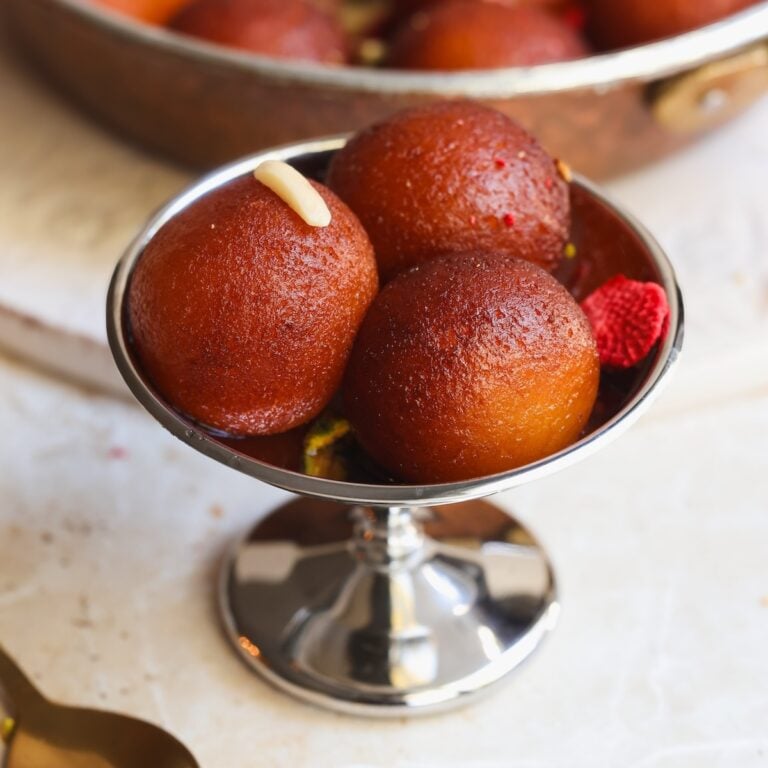
If you’ve never had homemade gulab jamun before, this recipe is about to change your life! They’re SO much better than ready made gulab jamun, and unbelievably easy to make in just one hour start to finish. This recipe cuts down the effort significantly by using milk powder instead of traditional milk solids (“khoya”), but still delivers the perfect gulab jamun: beautifully golden brown with a caramel-y toasted milk flavor, pillowy soft and juicy right to the middle, and not too sweet! This is the family recipe I grew up with in Pakistan, and is guaranteed to blow everyone’s mind, whether you serve it for Eid, Diwali, or a post dinner sweet treat.

These were incredible, Zoha! Reminded me of Gulab Jamuns back home, except, dare I say it… these were BETTER.
– Manha, ★★★★★
My 3 secrets for the perfect gulab jamun
After making this recipe countless times, I’ve learned that there are 3 secrets that result in the perfectly soft and juicy gulab jamun every single time:
- Adding an egg to the dough. I know this isn’t typical in most gulab jamun recipes, but I’ve found that adding an egg helps with structure and binding, prevents the balls from falling apart, and prevents them from absorbing too much oil while frying. However, if you don’t consume eggs, you can replace it with milk (about 3 1/2 tbsp)
- NOT kneading the dough! Shocking, I know, but trust me on this one! The dough has a lot of fat in it from the ghee, cream and milk powder. If you over handle it, it starts to “leak” oil, crack and is harder to work with. Kneading also develops gluten which can give gulab jamun a tougher texture. The key is to use a spoon to bring the dough together, mixing just until it’s smooth and starts to pull away from the edges of the bowl. Then chill until it’s semi-firm and you’ll have perfectly pliable dough you can gently form into smooth balls
- Getting the oil temperature just right. This is probably the single most important thing! If the oil is too hot, the gulab jamun will cook on the outside before they fully puff up, resulting in hard centers. If the oil is too cold, they will take too long to cook and fall apart. I recommend keeping the oil temperature between 310-320F

Step by step photos
These gulab jamun come together in 3 simple steps (full detailed instructions are in the recipe card below):
1. Make the dough balls


2. Fry the gulab jamun


3. Soak the gulab jamun


Then you’re ready to serve and enjoy! Personally, I love serving them warm right after a hearty Pakistani meal, like my tandoori chicken star bread or spicy Karachi biryani!

A few more tips!
Here are a few more helpful tips before you make this recipe:
- Use a kitchen scale instead of measuring cups. This will yield the most accurate results
- Also use a scale to ensure all dough balls are the same weight. This will ensure they all cook evenly at the same time (and it’s so fun to see the perfect balls!)
- Refrigerate the dough if it feels too sticky to work with. Just a few minutes will make it much easier to shape without over handling
- Fry one test gulab jamun first. This is a really helpful way to check if the oil is at the right temperature, and how long you need to cook them! It should take around 3-4 minutes to take on a deep golden brown color, and should at least double in size
- Be gentle with the balls while frying and soaking. They can crack and break easily!
- Don’t overcook the syrup. You need to cook only until the sugar has dissolved and it starts to simmer

Video Tutorial
Email This Recipe
Enter your email and I’ll send this directly to you. Plus you’ll get new recipes from me every week!
Ingredients
Dough balls:
- 1 cup full fat milk powder (100g) – I recommend Nido whole milk powder
- 3 tbsp all purpose flour (30g)
- 1 1/2 tsp baking powder
- 1 large egg – or substitute 3 1/2 tbsp whole milk
- 3 tbsp heavy cream (40g)
- 2 tbsp melted ghee or unsalted butter (30g)
Frying:
- Neutral oil to fry (~2″ deep in frying pan)
Soaking syrup:
- 1 1/4 cups water (300g)
- 1 cup granulated sugar (200g)
- 2–3 cardamom pods
- Optional: saffron and rose water if desired
Instructions
Dough balls:
- Mix the milk powder, flour and baking powder in a bowl and get rid of any lumps
- Separately whisk together the melted ghee, egg and cream until smooth
- Pour the wet ingredients into the dry ingredients, and use a spoon to mix them together. Use a press and swirl motion, getting rid of any lumps, until a shaggy dough forms that starts to pull away from the edges of the bowl. This should take 60-90 seconds only. Do not over-knead or overwork the dough. It’s fine for it to be soft and sticky
- Refrigerate the dough for 10-20 min until it is semi-firm and easy to shape. During this time, you can start heating the oil for frying as instructed below
- Once chilled, divide the dough into 15 equal pieces, about 16g each. I recommend a scale to ensure all pieces are the same weight
- Lightly rub some ghee or oil onto your palms and fingers. Working one piece at a time, roll the pieces gently between your palms, applying light pressure at first to make them smooth and crack-free. Then release the pressure and rotate your palms in opposite directions, with the ball in between, to make them into perfect spheres. This should be quick, and easy; avoid over working the balls as that can cause them to crack. If the dough feels too sticky during this process, place it back in the fridge for a few minutes
- Once all balls have been shaped, you can place them into the fridge while the oil heats up
Frying:
- While the dough is chilling, you can start heating the oil in a wok or large saucepan – make sure it’s at least 2″ deep. Heat it to ~310-320F on medium-low heat. At this temperature, if you drop a small piece of dough into the oil, it should take a few seconds to rise to the surface with some bubbles around it (not immediately)
- I always recommend frying 1 test gulab jamun first. Add one ball gently into the oil, and use a steel spider to gently swirl it around continuously. It should almost double in size, develop a deep golden brown color and be fully cooked through after 3-4 minutes. If it colors too quickly or starts to burn, the oil is too hot. If it takes longer to get color or starts to fall apart, the oil might be too cold
- Now fry the rest of the gulab jamun in 2-3 batches (I do 5 at a time to avoid overcrowding the pan). Keep gently swirling them so they get an even color all over, and fry for 3-4 minutes until golden brown. Place on a paper towel to drain
Soaking in syrup:
- While you’re frying the gulab jamun, you can work on the syrup alongside. Add the sugar, water and cardamom pods for the syrup into a large saucepan. Place on the stove on low heat, and stir occasionally. Cook only until the sugar has dissolved and the syrup starts to simmer. Then turn off the heat and cover with a lid
- By the time the balls are done frying, the syrup should still be hot. If not, turn on the heat to bring it to a simmer again, and turn it off. Gently drop all the balls into the syrup, and swirl the saucepan around a few times to encourage all sides of the gulab jamun to get soaked
- Cover with a lid and rest for at least ~20 minutes, or until the gulab jamun have soaked up nearly all of the syrup and almost doubled in size. I like to gently swirl the pan once more halfway through the soaking process
- Serve and enjoy!
Notes
- Make ahead and storage: You can prepare the gulab jamun ahead of time, and keep in an airtight container at room temperature for up to 1 day, or in the fridge for up to 5 days. I recommend warming up in the microwave to serve
Comments
Bakhtawer
This review has been a long time coming. I have made these two times and were loved by everyone. Very soft and dare I say, better than the ones I get from my local shops.
The thing I changed the second time around is to increase the amount of sugar syrup. These store really well in the fridge too. And I microwave them for 15 20 seconds to soften them.
In Sha Allah making them for Eid too. Thank you for an amazing recipe Zoha.
Zoha
Awww, you made my day, Bakhtawer! That’s so sweet of you. I’m so happy to hear you’re enjoying these and honored to be a part of your Eid spread!
Maisah A.
This is seriously a fool-proof recipe with amazing results! I was so intimidated by making gulab jamun, especially the frying aspect, that I never attempted it. Having a video to follow Zoha along with, as well as this easy recipe she developed were the magic formula. She even gave me suggestions as to what to do with sticky dough (worked out great) and jamun size (I made them too big at first). However, the true test was my desi husband. He LOVED them. They’re so much better than any packet mix or restaurant. Plus you can adjust the sweetness down if you’d like. Recommend having them the second day, as they’ve had a chance to really soak it all in. Mmm! Sooo good!
Zoha
Hi Maisah – this comment made my day! Thank you so much! I am SO happy to hear this recipe worked well for you – I am personally also quite biased to it as it’s my mom’s recipe and nothing beats Mama’s gulab jamun. 🙂
Hafss
Hey,
I’d love to try this recipe but can you please tell me if I could substitute something in place of the heavy cream?
your recipe are awesome as always!!
Zoha Malik
You need cream or malai!